
rail-pictures.com
Geen registratie nodig - login met Google-, Facebook- of X-account! Hallo gast, u bent niet ingelogd. Inloggen | Account aanmaken 
Forum   Contact   Colofon
Engels Duits Frans Italiaans Spaans Pools Nederlands 

1874 Bilder
<<  vorige pagina  34 35 36 37 38 39 40 41 42 43 n?chste Seite  >>
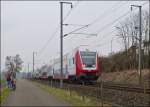
. A local train to Trier is running on the Sûre Bridge in Wasserbillig on April 8th, 2013.
. Een stoptrein naar Trier rijdt op 8 april 2013 over de Sûre-brug in Wasserbillig.
De Rond Hans und Jeanny

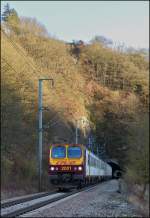
. The IR 3712 Luxembourg City - Troisvierges photographed in the nice landscape between Wilwerwiltz and Enscherange on April 14th, 2013.
Der IR 3712 Luxemburg Stadt - Troisvierges wurde am 14. April 2013 in der schönen Landschaft zwischen Wilwerwiltz und Enscherange fotografiert.
De Rond Hans und Jeanny

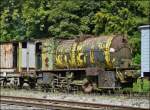
. Locomotive without boiler N° 123 with 2 axles, belonging to ARBED Differdange (formerly Hadir).  
Built in 1928 by  Meuse-Liège  under the number 3332. 
Power 285 hp, Weight: 38t.

Fond de Gras, September 13th, 2009.

The operating principle of the latter is a cylindrical tank mounted on a frame of steam locomotive and filled to about half of water is crossed by a stream of steam, about 10 bar pressure delivered by installation of steam fixed. At the end of this procedure of filling, the water in the tank of the locomotive took the temperature corresponding to the pressure of the steam introduced (ca. 200 ° C). The engine is disconnected from the filling station and can provide a traction advantage of heat energy in water embedded. As the locomotive rolls, water temperature and jointly vapor pressure led to the cylinder decreases. When a pressure of about 2 bar is reached, the locomotive must regain filling station and the cycle begins again.
Locomotief zonder ketel nr. 123 met 2 assen, behorend tot ARBED Differdange (voorheen Hadir). Gebouwd in 1928 door "Meuse-Liège" onder nummer 3332. Vermogen 285 pk, Gewicht: 38t. Fond de Gras, 13 september 2009. Het werkingsprincipe van deze is een cilindervormige tank gemonteerd op een frame van een stoomlocomotief en gevuld tot ongeveer halfvol met water, dat wordt doorkruist door een stoomstroom van ongeveer 10 bar druk geleverd door een vaste stoominstallatie. Aan het einde van deze vulprocedure heeft het water in de tank van de locomotief de temperatuur bereikt die overeenkomt met de druk van de ingevoerde stoom (ca. 200 °C). De motor wordt losgekoppeld van het vulstation en kan een trekkracht leveren dankzij de warmte-energie in het ingebedde water. Terwijl de locomotief rijdt, daalt de watertemperatuur en daarmee de dampdruk in de cilinder. Wanneer een druk van ongeveer 2 bar is bereikt, moet de locomotief terugkeren naar het vulstation en begint de cyclus opnieuw.
De Rond Hans und Jeanny

Luxemburg / Historische spoorwegen en musea / Trein 1900

751 1024x755 Px, 16.04.2013

. The trailer N° 112 (formerly motor coach N° 12) photographed in the Tramway and Bus Museum of the City of Luxembourg in Hollerich on April 27th, 2008.
. De aanhangwagen nr. 112 (voorheen motorwagen nr. 12) gefotografeerd in het Tram- en Busmuseum van de Stad Luxemburg in Hollerich op 27 april 2008.
De Rond Hans und Jeanny

. The motor coach N° 26 from 1938 and the trailer N° 121 pictured in the Tramway and Bus Museum of the City of Luxembourg in Hollerich on April 27th, 2008. 

The motor coach N° 26 and the trailer N° 121 were built in the service's workshops at Limpertsberg (Luxembourg). The construction of whole tramways was decided on during the 1920's and 1930's: on one hand, to reduce unemployment, which was quite significant at the time and, on the other, to reduce the communal budget deficit. When the tramway system was dismantled in Luxembourg, this motor coach and trailer were made available to the tramway museum de Schepdaal in Brussels due to a lack of space, while they were waiting to be brought back to Luxembourg again.
De motorwagen nr. 26 uit 1938 en de aanhangwagen nr. 121 gefotografeerd in het Tram- en Busmuseum van de Stad Luxemburg in Hollerich op 27 april 2008. De motorwagen nr. 26 en de aanhangwagen nr. 121 werden gebouwd in de werkplaatsen van de dienst in Limpertsberg (Luxemburg). De bouw van complete trams werd besloten in de jaren 1920 en 1930: enerzijds om de werkloosheid, die destijds aanzienlijk was, te verminderen en anderzijds om het tekort van de gemeentelijke begroting terug te dringen. Toen het tramsysteem in Luxemburg werd afgebroken, werden deze motorwagen en aanhangwagen ter beschikking gesteld van het tramuseum de Schepdaal in Brussel vanwege ruimtegebrek, terwijl ze wachtten om weer naar Luxemburg teruggebracht te worden.
De Rond Hans und Jeanny

. The CFL Cargo 318 taken in Esch Belval on March 4th, 2013.
De CFL Cargo 318 genomen in Esch Belval op 4 maart 2013.
De Rond Hans und Jeanny

. Locomotive without boiler N° V 12 with 3 axles, belonging to ARBED Dudelange. Built in 1956 by Jung-Kirchen Jungenthal/Sieg under the number 12513. 
Type designation by the manufacturer:  Felix . 
Power 250 hp, weight 39t.

Fond de Gras, September 13th, 2009.

The advantage of this type of locomotive it is very simple and robust, the most complicated of a normal locomotive (with boiler) is the boiler. It was so cheap to acquire and in maintenance. His conduct is easy and does not require highly skilled personnel. The exhaust of the locomotive is composed of only water vapor, gas combustion and smoke. It can therefore operate safely in areas covered and within the halls of manufacture. The disadvantage is of course to have a limited range and require a distribution network Steam. The latter was not available for all kinds of applications in the steel mills.
Locomotief zonder ketel nr. V 12 met 3 assen, behorend tot ARBED Dudelange. Gebouwd in 1956 door Jung-Kirchen Jungenthal/Sieg onder nummer 12513. Typeaanduiding door de fabrikant: "Felix". Vermogen 250 pk, gewicht 39t. Fond de Gras, 13 september 2009. Het voordeel van dit type locomotief is dat het zeer eenvoudig en robuust is, het meest gecompliceerde onderdeel van een normale locomotief (met ketel) is de ketel. Het was daardoor goedkoop in aanschaf en onderhoud. Het rijden is eenvoudig en vereist geen hoogopgeleid personeel. De uitlaat van de locomotief bestaat alleen uit waterdamp, verbrandingsgassen en rook. Het kan dus veilig opereren in overdekte gebieden en binnen productiehallen. Het nadeel is natuurlijk dat het een beperkte actieradius heeft en een stoomdistributienetwerk vereist. Dit laatste was niet beschikbaar voor alle soorten toepassingen in de staalfabrieken.
De Rond Hans und Jeanny

Luxemburg / Historische spoorwegen en musea / Trein 1900

1004 1024x755 Px, 16.04.2013

. Z 2013 and Robel 704 pictured together in Wasserbillig on April 8th, 2013.
. Z 2013 en Robel 704 samen gefotografeerd in Wasserbillig op 8 april 2013.
De Rond Hans und Jeanny

. 4010 is entering with bilevel cars into the station of Wasserbililg on April 8th, 2013.
. 4010 komt met dubbeldeksrijtuigen het station Wasserbillig binnen op 8 april 2013.
De Rond Hans und Jeanny

. The CFL 628 506 photographed in Luxembourg City on April 8th, 2013.
De CFL 628 506 gefotografeerd in Luxemburg Stad op 8 april 2013.
De Rond Hans und Jeanny

Luxemburg / Dieseltreinstellen / 628/928

785 1024x811 Px, 21.04.2013

<<  vorige pagina  34 35 36 37 38 39 40 41 42 43 n?chste Seite  >>


Statistik
 
Diese Webseite verwendet Cookies, um Inhalte und Anzeigen zu personalisieren und Zugriffe zu analysieren. Sie können zwischen personalisierter und nicht-personalisierter Werbung wählen.
Mit der Nutzung dieser Seite stimmen Sie der Verwendung von Cookies zu.